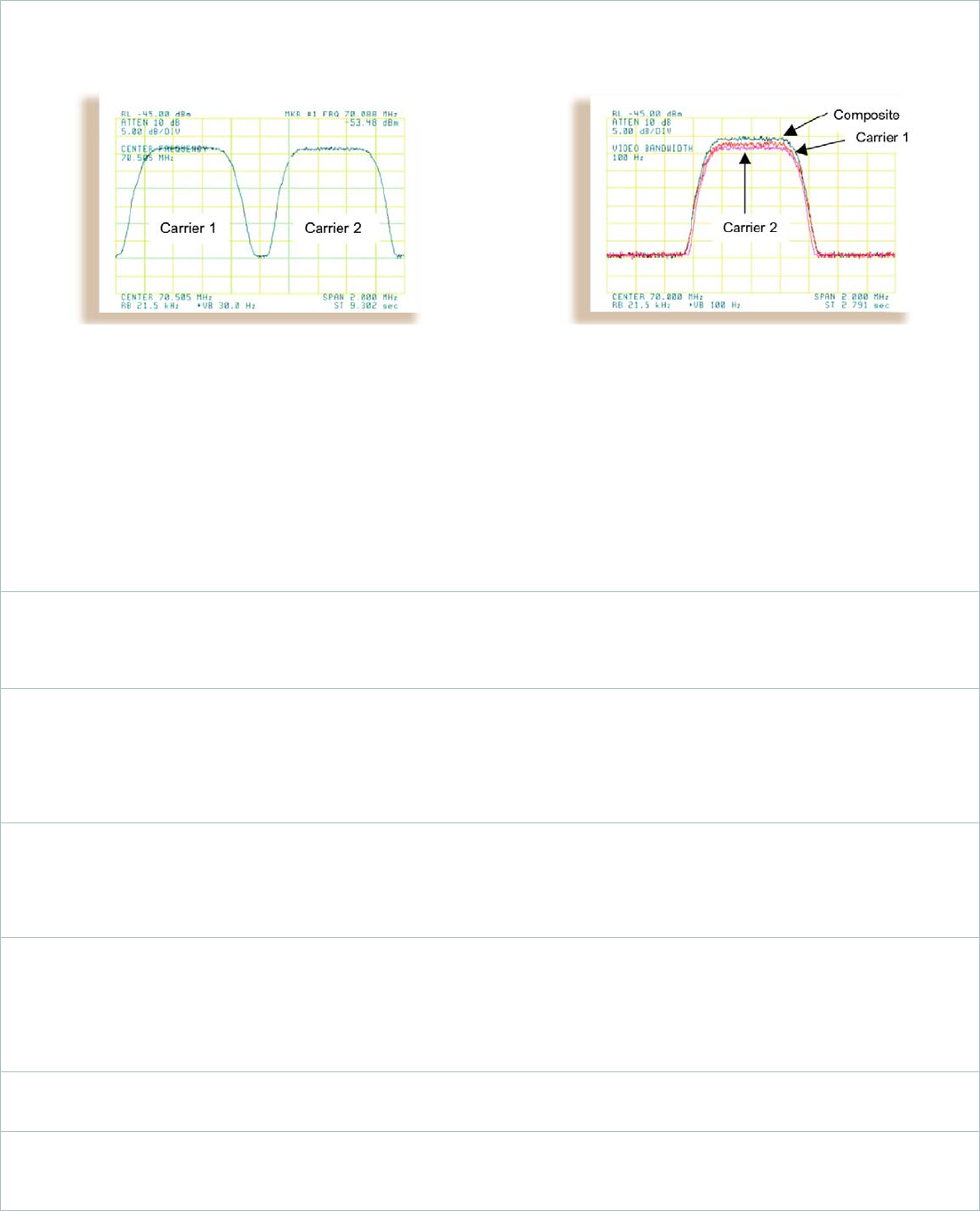
Figure 1 shows the typical full-duplex satellite link, where the two carriers are adjacent to each other.
Figure 2 shows the typical DoubleTalk Carrier-in-Carrier operation, where the two carriers are overlapping, thus sharing the same
When observed on a spectrum analyzer, only the Composite is visible. Carrier 1 and Carrier 2 are shown in Figure 2 for reference only.
As DoubleTalk Carrier-in-Carrier allows equivalent spectral efficiency using a lower order modulation and/or code rate, it can
simultaneously reduce CAPEX by allowing a smaller BUC/HPA and/or antenna. Alternatively, DoubleTalk Carrier-in-Carrier can be
used to achieve very high spectral efficiencies E.g., DoubleTalk Carrier-in-Carrier when used with 16-QAM approaches the bandwidth
efficiency of 256-QAM (8 bps/Hz).
When combined with VersaFEC or LDPC/TPC, it can provide unprecedented savings in transponder bandwidth and power utilization.
This allows for its successful deployment in bandwidth-limited and power-limited scenarios, as well as reduction in earth station
BUC/HPA power requirements.
Carrier-in-Carrier
®
is a Registered Trademark of Comtech EF Data
DoubleTalk
®
is a Registered Trademark of Raytheon Applied Signal Technology
is a Registered Trademark of Comtech EF Data
Carrier-in-Carrier Automatic Power Control (CnC-APC)
The patent-pending Carrier-in-Carrier Automatic Power Control (CnC-APC) mechanism enables modems on both sides of a CnC link to
automatically measure and compensate for rain loss while maintaining the Total Composite Power. In addition to automatically
compensating for rain loss, CnC-APC also enables the modems to share link margin, i.e. a modem in clear sky conditions can
effectively transfer excess link margin to a distant end modem experiencing fade, thereby further enhancing overall availability.
VersaFEC Forward Error Correction
CDM-625 is the first modem to offer VersaFEC, a patent-pending system of high performance short-block low-latency LDPC codes
designed to support latency-sensitive applications, such as cellular backhaul over satellite. VersaFEC provides excellent coding gain
with lowest possible latency. VersaFEC’s Eb/No performance is similar to that of DVB-S2 (short block) or LDPC (16k block) with 70-
90% lower latency. Compared to TPC, VersaFEC can provide coding gain of 1.0 dB or more.
The new Ultra Low Latency (ULL) codes provide even lower latency compared to standard VersaFEC codes.
Adaptive Coding & Modulation (ACM)
Satellite users have traditionally relied on worst case link margin to overcome rain fade which leads to significant inefficiencies.
ACM converts the fade margin into increased throughput – gain of 100% or more is possible. ACM maximizes throughput under all
conditions – rain fade, inclined orbit satellite operation, antenna mis-pointing, noise, interference and other impairments.
ACM can also be used with DoubleTalk Carrier-in-Carrier.
Low Density Parity Check Codes (LDPC) & Turbo Product Codes (TPC)
CDM-625 offers an integrated LDPC and 2
nd
Generation TPC codec. LDPC is an advanced Forward Error Correction technique
capable of providing performance much closer to Shannon limit. The current LDPC implementation can provide 0.7 to 1.2 dB additional
coding gain compared to an equivalent TPC code.
In order to take full advantage of the increased coding gain provided by LDPC, Comtech EF Data has developed a patented 8-QAM
modulation that allows for acquisition and tracking at much lower Eb/No compared to 8PSK.
CDM-625 supports 70/140 MHz and L-Band capability in the same unit with independently selectable transmit and receive IF. This
simplifies sparing and stocking in networks requiring 70/140 MHz and L-Band units.
4-Port Managed Ethernet Switch with VLAN & QoS
CDM-625 base modem incorporates a 4-port 10/100Base-T managed Ethernet switch with VLAN capability and priority-based Quality
of Service. Access (Native) Mode and Trunk Mode are supported. Traffic can be prioritized using port-based priority or VLAN priority.
The maximum Ethernet frame size with Rev 2 HW is 2048 bytes.

 (4 stránky)
 Manymanuals.com
 Manymanuals.de
 Manymanuals.fr
 Manymanuals.it
 Manymanuals.pl
 Manymanuals.cz
 Manymanuals.es
 Manymanuals-pt.com
Komentáře k této Příručce